A 3D-printed tissue-engineering scaffold for breast reconstruction, independently developed by the Personalized Tissue 3D Printing Team at Xi'an Jiaotong University's National Medical Research Industry–Education Integration Innovation Platform, is moving from the laboratory toward clinical implementation. This internationally pioneering technological achievement underwent pilot-scale development at Shenzhen Boruijie Biotechnology Co., Ltd., a company established to commercialize the team's patents. The team has successfully advanced the product into China's Special Review Procedure for Innovative Medical Devices, marking a key step toward scaled production and clinical application.
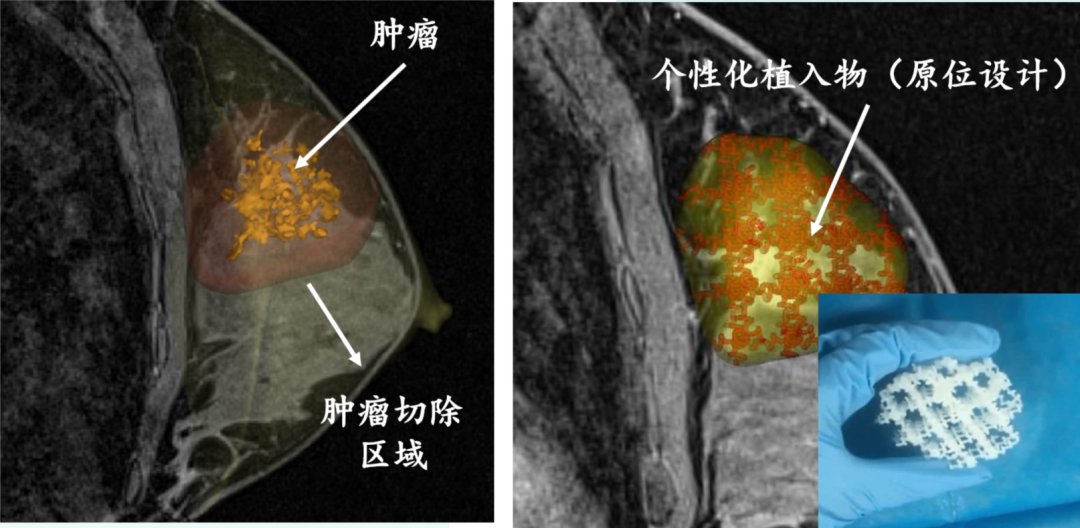
3D-printed tissue-engineering scaffold for breast reconstruction: flexible, biodegradable, and highly porous.
A New Approach to Breast Tissue Defects: Guiding Tissue Regeneration with a Biodegradable Scaffold
Breast cancer is the most common malignant tumor among women in China, with more than 400,000 new cases annually. As early diagnosis and standardized treatment have become more widespread, breast-conserving surgery has become an important treatment for early-stage breast cancer. Repairing the resulting breast tissue defects, however, remains a technical challenge in breast surgery. Clinical practice mainly uses two approaches: transplantation of autologous tissue, which creates a second injury at the donor site; or implantation of silicone prostheses, which carry the long-term risk of requiring another operation for removal after several years.
The 3D-printed biodegradable tissue-engineering scaffold offers a different approach. Rather than aiming for permanent replacement, it acts as temporary structural support, providing the space and mechanical environment needed for tissue regeneration. After implantation, it can induce host cell adhesion, proliferation, and ingrowth, promote new blood vessel formation and regeneration of breast soft tissue, and ultimately reconstruct the external shape of the breast defect.
Its technical characteristics are reflected in three main aspects:
Controlled degradation
After performing its supporting and guiding functions, the scaffold gradually degrades and is absorbed in the body, without requiring a second operation for removal.
No permanent foreign material left behind
This avoids long-term risks associated with silicone implants, such as capsular contracture, displacement, and rupture.
Stable shape retention
The combination of flexible materials and biomimetic structural design helps maintain the postoperative appearance over the long term.
These characteristics reflect a shift in the repair concept from foreign-material replacement toward regeneration of the patient's own tissue.
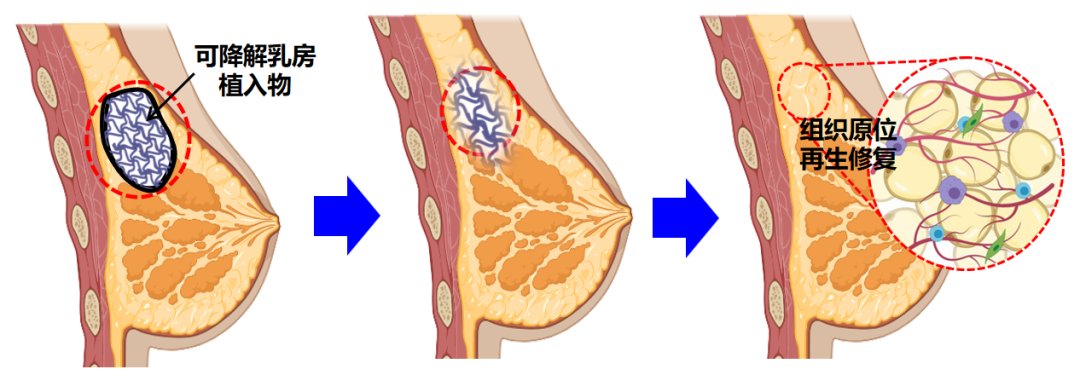
Operating principle of the 3D-printed tissue-engineering scaffold for breast reconstruction.
An Additive Manufacturing Breakthrough: From Passively Guiding Regeneration to Actively Participating in It
The scaffold's internal pore structure is a key factor influencing tissue regeneration. If pores are too large, cells lack sufficient adhesion interfaces. If they are too small, cell migration, ingrowth, and vascularization are hindered. If the mechanical properties do not match surrounding tissue, the scaffold may also become structurally unstable before new tissue forms. Additive manufacturing provides an effective way to construct these structural parameters in a controlled manner.
By commercializing its patents through Boruijie, the team established a methodological system for additive manufacturing of medical materials. This enables integrated design and fabrication of the scaffold's interconnected pore structure, porosity, degradation period, and mechanical strength, offering significantly greater structural freedom than conventional molding.
Building on this, the team is upgrading the technology along two major directions. Together, these take the product beyond its basic function of guiding controlled tissue ingrowth toward improving the speed, depth, and activity of ingrowth. They address limitations of conventional scaffolds, including slow and insufficiently deep ingrowth, uneven internal tissue filling, and difficulty reconstructing vascular networks.
The first direction uses oriented microchannel design to control cell migration and distribution. The proposed approach combines a 3D-printed biodegradable scaffold with a suspension of short polycaprolactone (PCL)/gelatin nanofibers. This creates oriented microchannels connected to larger macropores, forming a multiscale fibrous scaffold that guides cells to infiltrate uniformly into deeper regions along predetermined directions.
The second direction uses cell-laden hydrogels to improve the activity of regenerated tissue. Stem-cell-loaded microgels and vascular endothelial cells are delivered together into the scaffold, creating a prevascularized, highly permeable living construct validated in animal models. This upgrades the scaffold from inert structural support into an active carrier containing seed cells and offering vascularization potential.
Product Development Milestone: Entry into the National Special Review Procedure for Innovative Medical Devices
Innovative drug and medical-device products usually need to be assessed along two dimensions: originality and leadership in design, and their technological value in filling unmet clinical needs. In May 2026, China's National Medical Products Administration published its “Notice of Review Results for Applications to the Special Review Procedure for Innovative Medical Devices.” The 3D-printed tissue-engineering scaffold for breast reconstruction passed selection and formally entered the procedure. The product is an international first in breast surgical reconstruction.
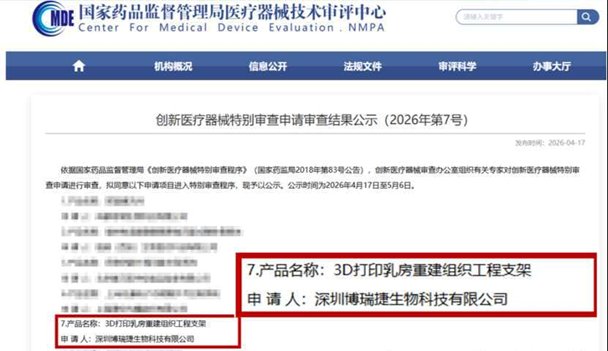
National Medical Products Administration notice for the special review of innovative medical devices.
Technology Outlook: Expanding Biodegradable Implants Across Applications
The breast reconstruction scaffold is the first breakthrough direction for the platform for biomanufacturing biodegradable medical implants. Addressing the international challenge of personalized regeneration and repair of human soft tissues and organs, the platform is being used to develop a series of independently originated 3D-printed biodegradable implants. These will extend personalized, biologically active precision-treatment strategies to broader clinical settings, including biodegradable external tracheal scaffolds and biodegradable rib implants.
These products follow the same technological logic: use additive manufacturing to customize structure, use biodegradable materials to withdraw at the appropriate time, and rely on the patient's own cells to reconstruct tissue.
The next steps are to continue advancing scaled production and clinical translation of biodegradable scaffolds and, through the biodegradable medical implant biomanufacturing platform, expand their applications in soft tissue and organ regeneration and repair.
Source: Xi'an Jiaotong University National Medical Research Platform.
Original link: https://mp.weixin.qq.com/s/YKxghC9nrIzGrg0kO0Q2zw
AI-translated from an article by Kuaixiong on Nanjixiong, originally published on 2026-10-27. Text and images retain the original source attribution.
Read the original Chinese article |



 Record number | ©2024 panda3dp Team. Powered by panda3dp