Nanjixiong introduction: A common question about metal 3D printing in aviation is whether it can make primary load-bearing structures. AVIC Shenyang Aircraft Design and Research Institute recently shared work by its Key Laboratory of New-Concept Aircraft Structures. Applications range from small secondary-load parts such as angle boxes and profiles to integrated primary structures over five meters long and multifunctional annular heat exchangers with complex internal channels. The structures are in use in several aircraft programs and projects.
On November 17, 2026, Nanjixiong learned that the institute had disclosed progress in developing 3D printed aircraft structures. The laboratory uses metal additive manufacturing for frames, beams and panels to reduce dependence on conventional tooling, machining and mechanical assembly, supporting larger integrated and lightweight structures.
From drawings to airframes
Aircraft design and manufacturing have traditionally been separate activities, as have structural and functional development. Laboratory designer Xing Bendong said bold designs can remain on paper when existing processes cannot make them, increasing the risk of schedule, weight and cost overruns.
Deputy director Cui Can said 3D printing's rapid response, lack of tooling and ability to form complex structures accelerate prototype development. It integrates design with manufacturing and function with structure, allowing greater design freedom. The article describes a laser following a computer model and planned paths to melt metal powder layer by layer.
Primary structures over five meters long
One recent development is a large, integrated, additively manufactured primary structure over five meters long. Located in the aircraft's center fuselage, the frame-and-beam component carries and transfers loads.
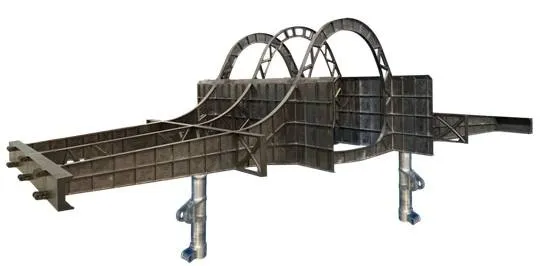
Conventional large aircraft assemblies combine subtractive manufacturing with mechanical assembly. Numerous joints add weight, while fastener holes can be prone to fatigue cracks, limiting lightweight and long-life designs. Xing said integrated 3D manufacturing creates a three-dimensional whole, substantially reducing the number of structural pieces, connectors and fasteners. Fewer mechanical joints reduce weight and extend service life.
An annular heat exchanger with complex internal channels
The laboratory also develops structures for confined spaces. A 3D printed multifunctional annular heat exchanger inside an aircraft inlet combines heat exchange, air extraction, load bearing and maintenance functions.
Conventional thin-sheet welded heat exchangers have simple internal passages and face constraints on further weight reduction and efficiency. Designer Wang Fuyu and colleagues incorporated manufacturing requirements into design. After multiple design, prototype and test iterations, they increased heat transfer area while lowering weight.
Rough internal surfaces posed a challenge for service life and cleanliness. Conventional treatments could not reach the channels or risked damaging the structure. The team developed a dedicated internal-channel grinding device using fine steel pins driven by an external magnetic field to slide and roll against the surfaces.
Segmented builds and staged validation
A printed laboratory sample still requires qualification for use. Cui said additive manufacturing accumulates thermal stress, with larger build areas increasing stress and the risk of distortion and cracking.
The team developed a method combining separately printed segments with additive fusion joining. Segments are printed and rough-machined, joined using the same process, then finish-machined. The article says this approach subsequently became widely used for large additive structures.
Large primary components undergo staged validation. Small coupons and test bars establish process and material properties. Representative frame-and-beam sections are then tested for load-bearing performance. Full-scale structural sections undergo static testing. For the heat exchanger, cyclic loading life tests were particularly challenging. A failure would require reworking the design. Wang recalled that the final pass felt calm because confidence had accumulated through each earlier test.
Six processes, thirteen materials and nineteen structural categories
The laboratory reports aircraft applications using six additive processes, thirteen metal materials and nineteen types of 3D printed structures. These range from secondary structures such as angle boxes and profiles to integrated primary structures, annular heat exchangers, boarding ladders, ducts, rocker arms and brackets.
Its team has seventeen members, all with master's or doctoral degrees. Recent awards include a second prize in the National Technological Invention Awards, first and second prizes in defense science and technology progress, and twelve other provincial or ministerial awards. More than twenty years of work have linked new-concept structures, key technology development and engineering application.
Nanjixiong's observations
The report shows the broader engineering capabilities needed to move from secondary to primary aircraft structures. Segmented printing and fusion joining, magnetic finishing of internal channels and staged tests from coupons to full-scale structures all support practical implementation. Materials, equipment, processes and qualification need to advance together with aircraft manufacturers' requirements.
Source: AVIC Shenyang Aircraft Design and Research Institute, via AVIC's WeChat account.
Original article
AI-translated from an article by Beijixiong on Nanjixiong, originally published on 2026-11-17. Text and images retain the original source attribution.
Read the original Chinese article |



 Record number | ©2024 panda3dp Team. Powered by panda3dp