Nanjixiong introduction: Powder handling is often simplified to mixing, breaking up clumps, and loading. Yet metal, ceramic, and polymer powders are highly sensitive to particle-size distribution, flow, apparent density, oxygen content, satellite and hollow particle fractions, inclusions, and batch consistency.
In October 2026, Nanjixiong learned that Qidong Gaoneng was applying a material-property-driven shear-field approach to printing powders. Rather than merely increasing speed, it manages powder condition as a process parameter. Shared control architecture, modular liners, and validation services aim to reproduce laboratory formulations reliably at production scale.
Four Common Powder-Handling Problems
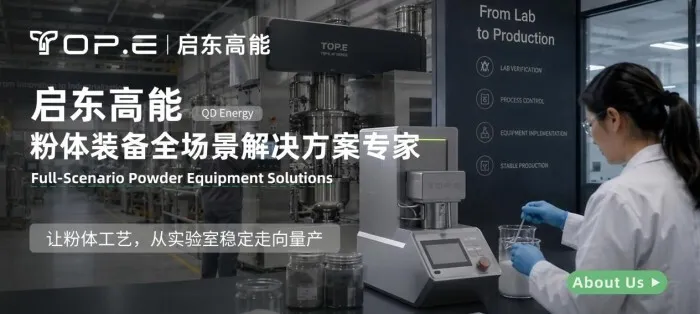
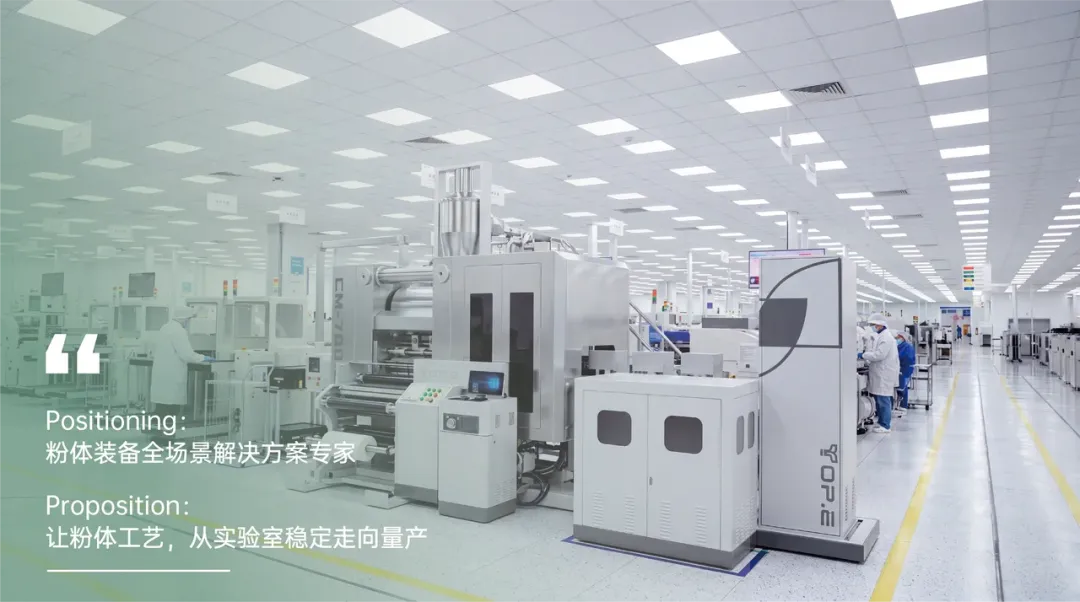
Qidong Gaoneng, part of Gaoneng Shuzao, is a core powder-equipment manufacturing base in Qidong, Jiangsu. Its powder, polymer, and slurry equipment spans high-speed mixing, kneading/compounding, and roll-to-roll film formation. It serves advanced materials, fine chemicals, pharmaceuticals, and functional foods, emphasizing stable laboratory-to-production transfer.
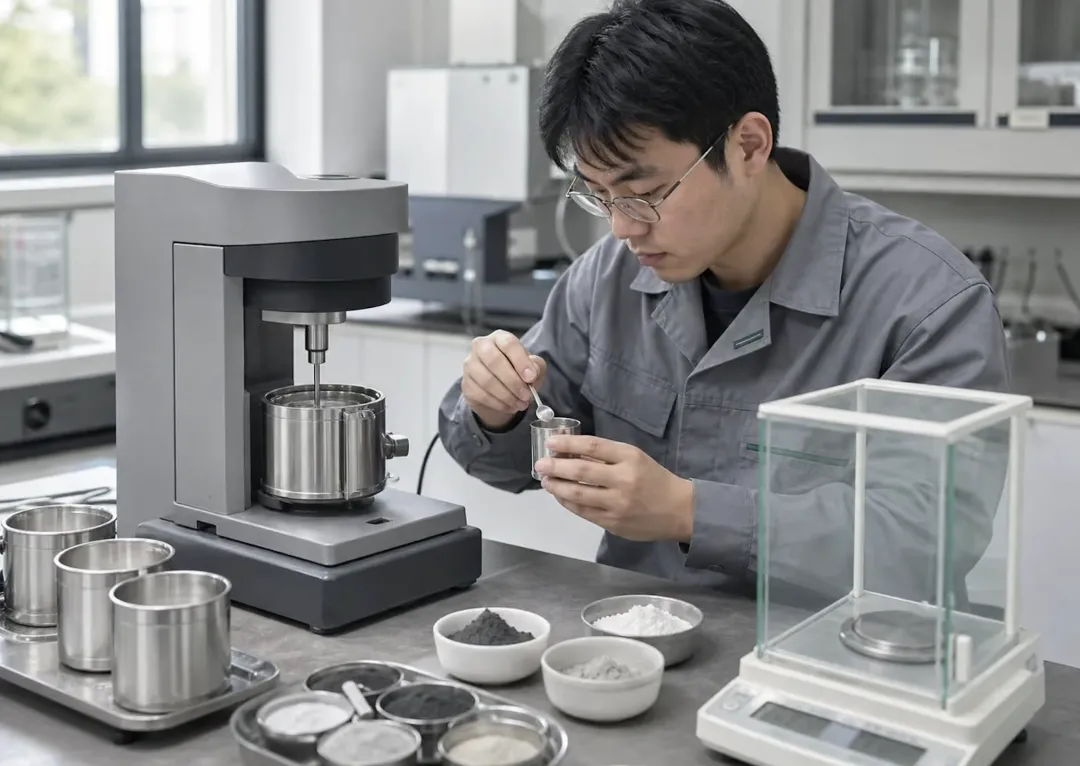
Persistent agglomeration. Moisture and static make powders clump. Adding liquid additives all at once creates wet-outside, dry-inside clusters that grow harder with mixing. Mechanical shear forcibly breaks them but does not remove molecular forces and humidity, so they can reform.
Segregation of heavy and light powders. Components with widely different sizes and densities separate under high-speed centrifugation. Heavy particles move outward, while trace flavors and additives distribute unevenly, creating quality differences within one batch.
Frictional heating. High speeds generate heat. In nanotube dispersion, nanopowder modification, and carbon-black mixing, accumulated heat can decompose surface modifiers or produce uneven coatings and inconsistent batches. Faster is not always better.
Residue and wear contamination. Excess blade-to-wall clearance leaves dead zones and cross-contamination during changes. Abrasive materials wear blades and introduce metal contamination, a critical defect for high-purity ceramics and pharmaceutical powders.
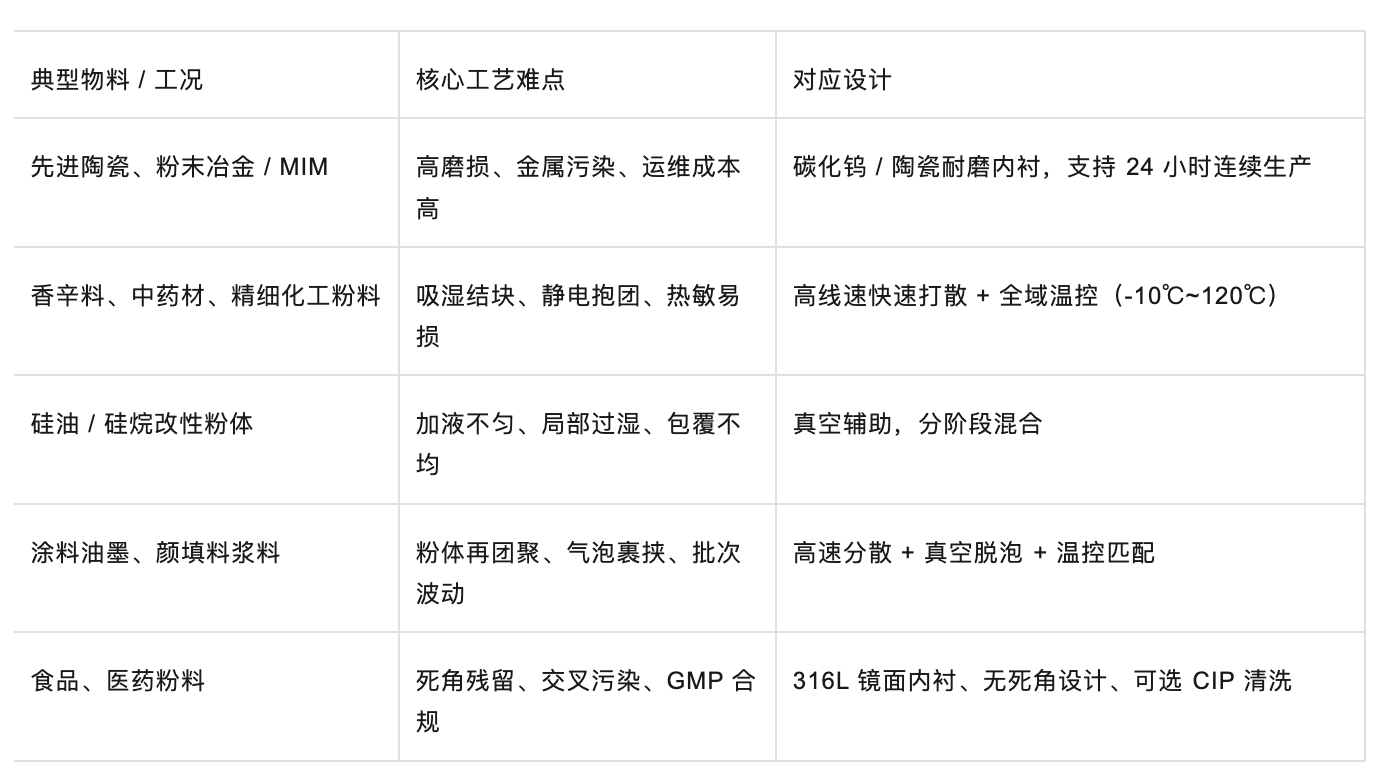
Wear-resistant liners reduce metal fragments; quick-change liners limit contamination across grades and formulations. Replacing liners rather than dismantling the machine also suits multi-formulation research and continuous production.
A Modular Solution
Rather than selecting mixers solely by volume and speed, Gaoneng divides equipment into five functional modules—shear, vacuum, temperature, vessel/materials, and control—targeting specific process problems.
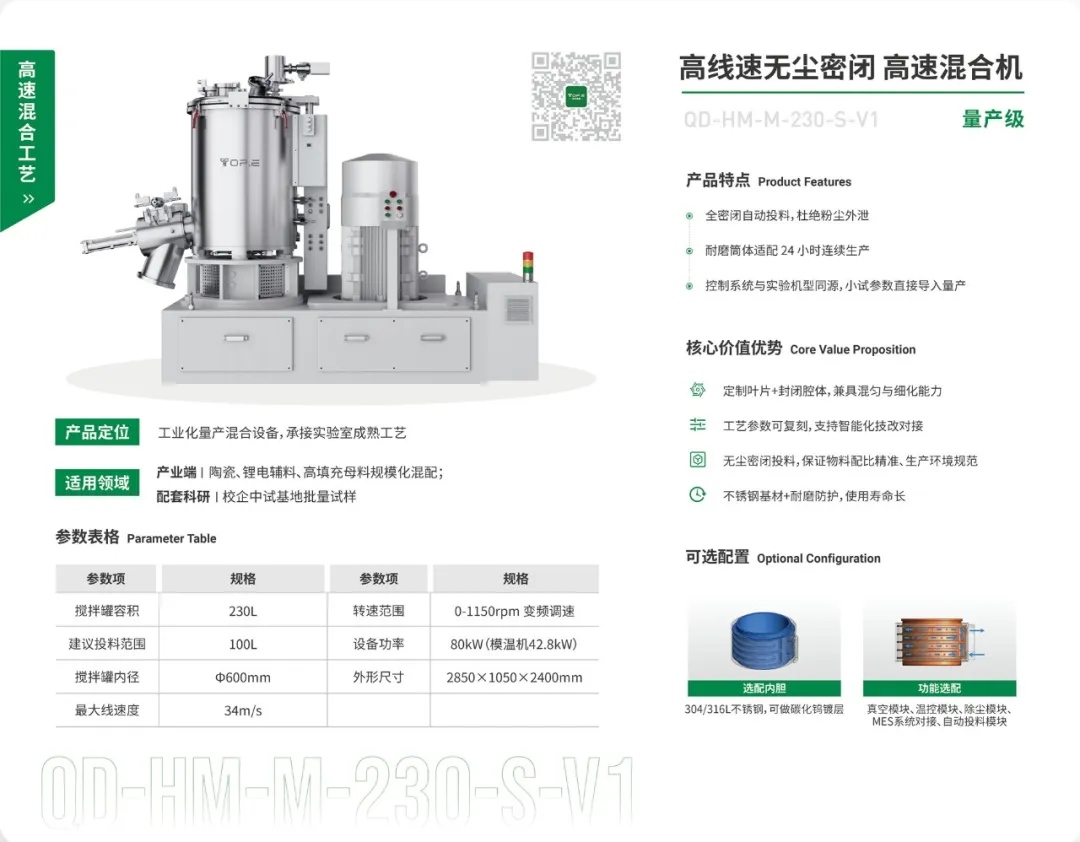
Shear. Force distribution targets agglomeration-prone zones rather than simply raising rpm. High-linear-speed blade regions follow principal material flow, while cutter groups create frequent shear where clumps form. Intensity is graded according to hardness and heat sensitivity, dispersing agglomerates without degrading sensitive ingredients.
Vacuum. Staged operation replaces continuous high vacuum. Early evacuation removes trapped interparticle air and breaks wet-outside, dry-inside clusters. Mild vacuum later suppresses new bubbles. Vacuum during liquid addition promotes uniform penetration and prevents local overwetting.
Temperature. Full-area jackets cover vessel walls and bottom and coordinate with speed profiles. Control matches thermal sensitivity: low-speed wetting first, high-speed dispersion next, and low-speed homogenization last, keeping batch temperature rise within allowable limits.
Vessel and materials. Mirror-polished walls, precisely controlled blade clearance, and rounded transitions eliminate dead zones. Multiple replaceable liners address abrasion and purity, prevent cross-contamination, and allow replacement after wear without dismantling the main machine.
Control. A shared architecture across the range transfers laboratory processes to production. Multistage speed, vacuum, temperature, and time programs can be saved and recalled with one click. Validated parameters import directly to production machines, avoiding repeated experimentation.
How to Cooperate
Process validation precedes equipment delivery. Customers first submit materials for testing; modules and configurations are selected after the process is confirmed.
Customers facing agglomeration, segregation, or temperature rise in heat-sensitive materials can contact Qidong Gaoneng, provide material information, and request testing.
Nanjixiong's Observations
Powder preparation is an underestimated upstream stage. Attention focuses on lasers, scanning, and grades, while agglomeration, segregation, oxygen, inclusions, and consistency often determine reproducible part performance. Modular mixing, vacuum, thermal control, vessel materials, common controls, and validation align with the laboratory–pilot–stable-production pathway.
The next test is sustained operating data for protecting metal particle morphology, avoiding ceramic contamination, managing polymer thermal sensitivity, and homogenizing recycled powder. If demonstrated, the company becomes a process-equipment service provider for consistent powder condition, beyond a mixer supplier.
AI-translated from an article by Xiaoruanxiong on Nanjixiong, originally published on 2026-11-04. Text and images retain the original source attribution.
Read the original Chinese article |



 Record number | ©2024 panda3dp Team. Powered by panda3dp