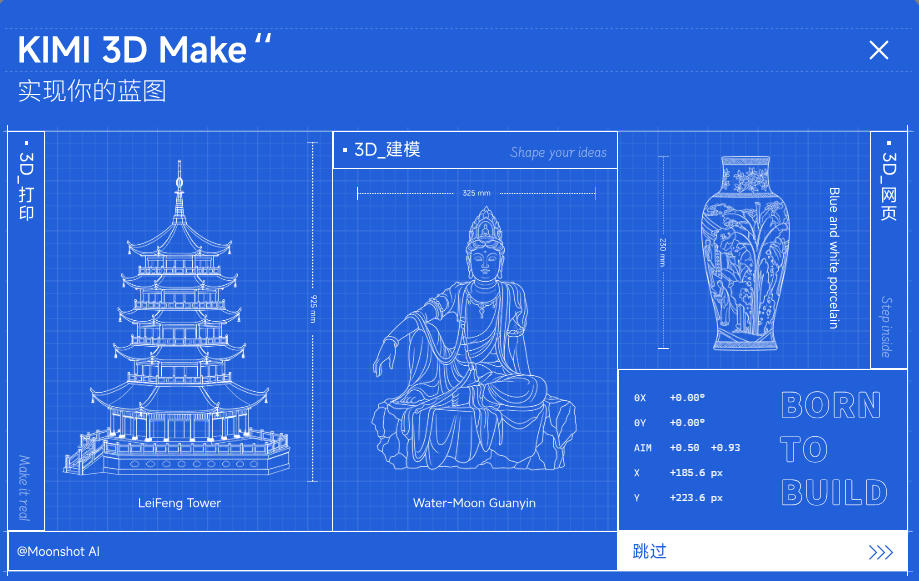
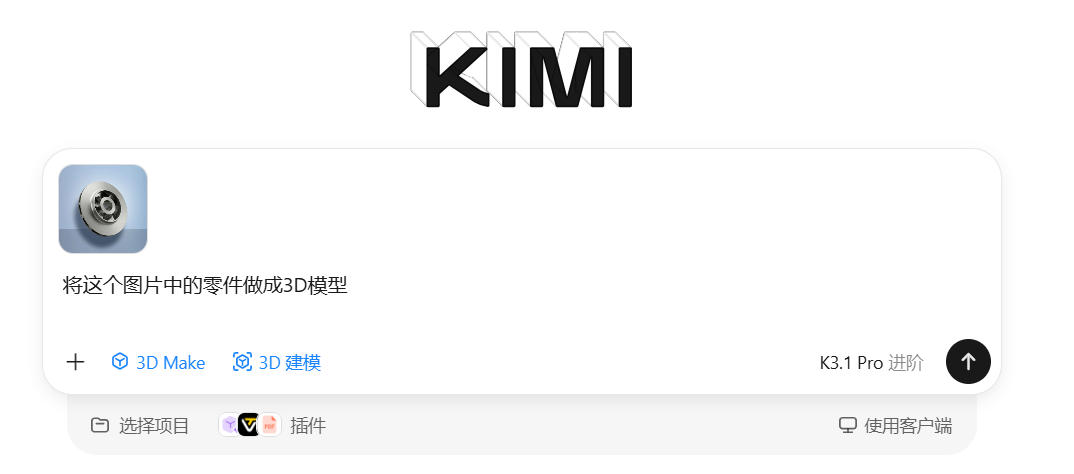
On October 24, 2026, Nanjixiong learned that Moonshot AI had officially released its Kimi K3.1 Pro large model and simultaneously launched a standalone product page, Kimi 3D Make. It supports generating 3D models directly from text, sketches, and reference images, with 3D printing identified as a core application. Its central approach is for the model to write executable scripts for professional software such as Blender and FreeCAD, run them in the cloud, and output standard CAD files. This is native parametric modeling by a general-purpose large model, rather than simple integration of a third-party API.
I. General-Purpose Models Enter the Market: 3D Generation Is No Longer Exclusive to Specialists
Just six months ago, AI 3D generation immediately brought to mind specialist startups such as Meshy, Tripo, Hyper3D, and Hi3D. Since the third quarter of 2026, however, the competitive landscape has changed fundamentally.
OpenAI's GPT-6 Astra, released in September and positioned as the world's strongest computer-use model, can directly operate professional modeling software such as Blender and FreeCAD, completing the workflow from a text description to a full model file. An official demonstration showed Astra building a house with a swimming pool in Blender and importing it directly into Unreal Engine to create an interactive scene.
Anthropic's Claude Opus 5.5 has likewise substantially improved spatial reasoning and code generation, achieving the highest scores among general-purpose models in current public CAD benchmarks. In China, Tencent's Hunyuan 3D world model has reached version 2.0 with some capabilities open-sourced. SenseTime and Baidu have also implemented 3D generation in spatial intelligence and industrial digital twins, respectively. The shift toward 3D capabilities in general-purpose large models is an industry-wide trend.
Kimi's particular significance is that it makes script-based parametric modeling directly available to consumers. Leading specialist 3D AI companies have also begun adding parametric script generation. The two approaches are not entirely opposed; competition will ultimately center on precision, detail, and suitability for specific applications.
II. Four Effects on the 3D Printing Industry
General-purpose models entering 3D generation mean more than another modeling tool. They will bring changes to demand, supply, business models, and industry structure.
1. Completing the Final Piece for Consumer Adoption
With desktop 3D printer prices falling to around a thousand yuan and printing stability greatly improving, content has become the public's main concern. Ordinary users cannot use SolidWorks or Blender. After purchasing a printer, they can only print other people's designs from model communities, leaving creative demand constrained.
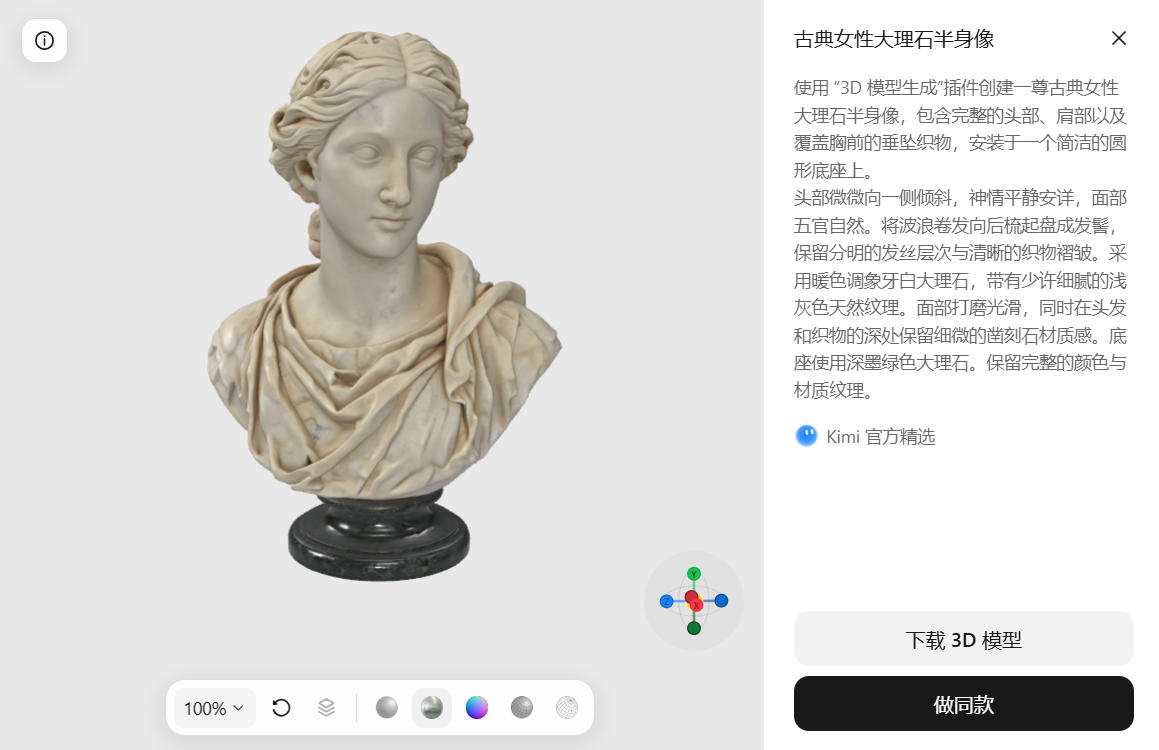
AI 3D generation is removing this barrier. Bambu Lab's MakerWorld already integrates multiple models including Hunyuan 3D, Tripo, Meshy, and Hi3D. Users can generate a printable model by uploading a photo. At TCT Asia 2026, Meshy reported that its generated character figurine models had reached a 97% slicing pass rate. Kimi 3D Make also supports STL export. Simple structural models can be sliced and printed directly, while complex models still need wall-thickness repair and feature optimization according to process requirements.
As describing what you want and printing it becomes usable rather than conceptual, 3D printers will move from geek toys into ordinary homes. This is not a distant forecast: Bambu Lab has publicly confirmed that its software R&D team now exceeds its hardware team in size, clearly signaling the industry's shift from hardware to content ecosystems.
2. Compressing Industrial Design Workflows and Sharply Reducing Small-Batch Customization Costs
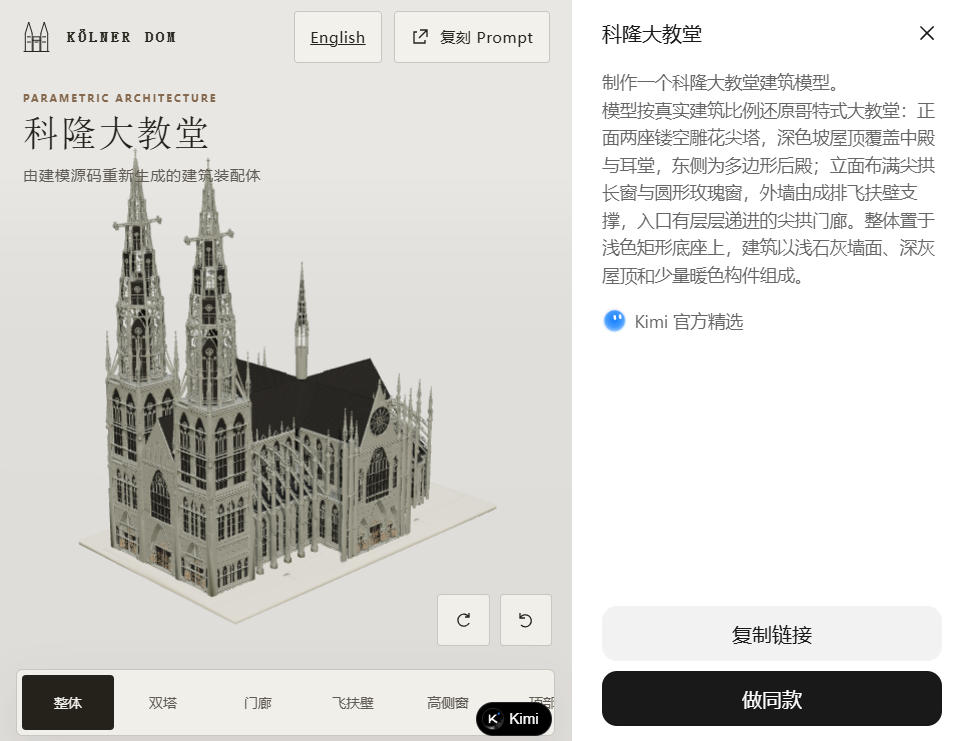
Parametric modeling by general-purpose models has even greater industrial value. Models represented by K3.1 Pro excel at structured modeling of mechanical parts, architectural models, and customized furniture. Users can change dimensions or structures through natural-language descriptions, and the model updates automatically.
Traditionally, engineers might spend days moving from requirements discussions to CAD drawings. With AI, iterations at the proof-of-concept stage can shrink to minutes. For 3D printing service providers, this significantly reduces the marginal cost of small-batch custom orders. In future, one operator working with AI could handle a comparable volume of requests.
More profoundly, generative design and 3D printing will become more closely integrated. Models can automatically optimize structures according to printing processes (FDM/SLA/SLS), material properties, and load requirements, generating lightweight forms outside conventional design thinking and realizing additive manufacturing's geometric freedom.
3. Restructuring Model Platform Ecosystems
Platforms such as Thingiverse, MakerWorld, and Printables traditionally derived their core value from aggregating models uploaded by creators. Users were consumers, while creators were a small professional group.
Once AI 3D generation becomes widespread, every user can produce models. Platforms' core value will shift from model libraries toward printing parameter optimization, quality screening, and community exchange.
Some platforms have already begun this transition. After MakerWorld introduced AI generation, users began sharing combinations of prompts, print parameters, and outcome ratings rather than only finished-product photos. This hybrid of user-generated content and AI may become the standard for the next generation of model communities.
4. Education and Maker Markets May Grow First
Education benefits most directly from lower barriers. 3D printers are already common in school and university makerspaces and STEAM courses, but modeling has remained a teaching challenge. AI modeling tools let students quickly turn classroom ideas into physical objects without spending semesters learning CAD.
Nanjixiong believes that as widely used models such as Kimi gain native 3D generation, schools and training institutions will face fewer obstacles when deciding to purchase 3D printers. The education market could see another growth peak in 2027.
III. Specialist AI 3D Companies: Narrower General-Purpose Opportunities and Stronger Differentiation
For startups such as Tripo, Meshy, Deemos, and Hi3D, the collective entry of general-purpose models significantly changes the competitive environment.
The past two years brought rapid growth for specialists. In September 2026, Meshy announced annual recurring revenue above USD 100 million, a hundredfold increase in less than two years. Since Q2 2026, Tripo AI's monthly visits have quickly risen from several million to more than 28 million, bringing it into the mainstream tool category. Deemos completed a Series B round of several hundred million yuan in June 2026, while Shumei Wanwu completed a USD 50 million round in August. According to The Business Research Company, the AI-in-3D-printing market grew 39.8% year on year from 2025 to 2026, making it the fastest-growing segment of additive manufacturing.
But as general-purpose models enter with enormous user bases, abundant computing resources, and stronger semantic understanding, specialists' room to operate is changing. Nanjixiong expects several clear divisions to emerge.
1. Pressure in General Applications, Stronger Barriers in Specialized Ones
Kimi, GPT, and Claude offer strong general capabilities, large user bases, and convenient access. Their 3D generation, however, is essentially an ancillary feature of a large model and will not be optimized to the utmost for every specialist application, such as 3D printing, game assets, and visual effects.
An ordinary user may use Kimi to print a small ornament, but game studios developing next-generation assets and figurine manufacturers making high-precision prototypes before tooling will still choose professional tools.
2. Pricing Pressure on Basic API Services
API services are an important revenue source for many AI 3D specialists. When Kimi and GPT can generate models themselves, and developers already use their API ecosystems, general-purpose models will divert basic text-to-3D and image-to-3D demand.
For basic text/image-to-3D-mesh needs in particular, general-purpose models will gradually take over general applications. Specialists must either price their basic APIs more competitively or provide advanced capabilities that general models cannot deliver, such as automatic topology, UV unwrapping, rigging, and industrial-precision modeling. Otherwise, basic API businesses will face continuing pressure on both prices and traffic.
3. Deep Integration with Hardware and Software Is an Important Path
Standalone tools face substantial competition for traffic from general-purpose models. Embedding in hardware workflows and deeply adapting to manufacturing processes offers a steadier path. Bambu Lab's integration of several models while developing its own print optimization is a typical example. Generating a model is only the first step; printing it successfully and attractively requires deep knowledge of slicing algorithms, materials, and process parameters.
Deep partnerships between AI 3D companies and printer, CAD, and slicing software manufacturers will become increasingly important. Specialists' core value lies in the intermediate adaptation layer that general models do poorly and hardware manufacturers cannot build themselves.
4. Greater Likelihood of Consolidation
General-purpose model companies can add 3D capabilities through internal development or acquisition. Kimi and OpenAI chose internal development, but not every company will. For model providers lacking 3D expertise, acquiring a mature AI 3D startup is faster.
Leading 3D printing companies may also acquire AI teams to strengthen software capabilities. Nanjixiong expects the probability of mergers and acquisitions to increase significantly over the next 12 months.
Nanjixiong's Observations
Kimi 3D Make is part of the broader penetration of general-purpose models into 3D space. From GPT-6 Astra and Claude Opus to Kimi K3.1 Pro, leading providers have strengthened 3D modeling and spatial reasoning within almost the same time window. This is no coincidence.
For 3D printing, this is clearly positive overall. Lower modeling barriers continually expand demand, eventually benefiting printer sales, printing services, materials, and consumables across the chain. Benefits will not be distributed evenly: companies that quickly embrace AI and reshape products will capture growth, while those holding to traditional models will feel increasing pressure.
For AI 3D startups, the phase of easy expansion is passing. Previously, being a little faster or producing slightly better results could drive rapid growth. Facing general-purpose models with hundreds of millions of users, they must now identify specialist value that is truly irreplaceable.
AI-translated from an article by Beijixiong on Nanjixiong, originally published on 2026-10-28. Text and images retain the original source attribution.
Read the original Chinese article |



 Record number | ©2024 panda3dp Team. Powered by panda3dp