For 3D printing enthusiasts, owning a 3D printer is only the beginning. Turning an idea in the mind into a 3D model is another unavoidable challenge. Making a personalized ornament, creative figurine or distinctive household item all require first creating a model. Users without professional modeling experience need time to learn modeling software, while resources in existing model libraries may not match what they have in mind.
How can the barrier to 3D model creation be lowered so more people can turn ideas into models? N4D (formerly abbreviated Neural4D) is exploring a new approach to 3D printing creation.
The 2026 TCT Shenzhen exhibition took place at the Shenzhen World Exhibition & Convention Center in Bao'an from October 14 to 16. N4D, an AI 3D brand under Gezhi Technology, demonstrated image-to-3D, text-to-3D and CAD Agent capabilities at booth E85 in Hall 15, exploring how AI modeling can work with 3D printing applications and provide creators with new ways to create and design models.
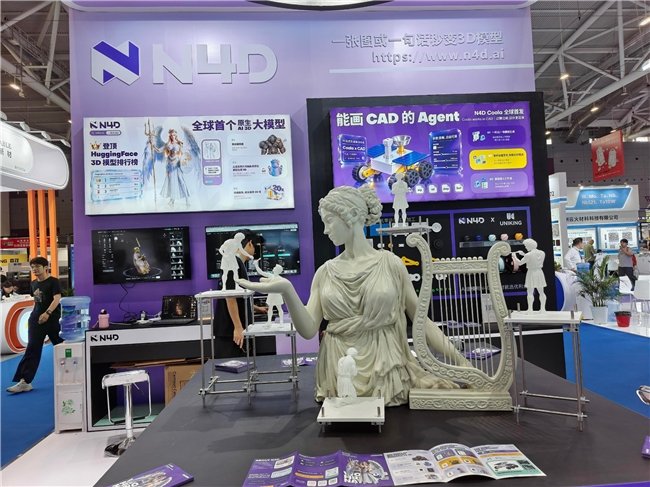
AI-generated 3D models reshape how creative designs are realized
In a conventional 3D printing workflow, models are created using professional 3D software. For users without modeling experience, building a model from scratch is difficult. Even when they find an existing model, its shape may not meet their expectations or it may lack personalized elements.
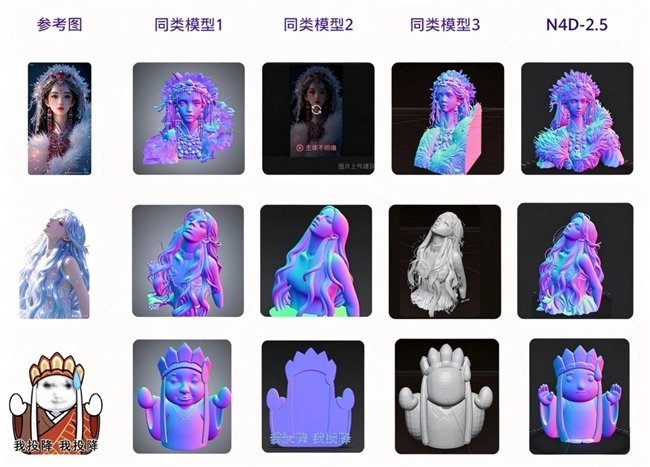
N4D provides image-to-3D and text-to-3D functions. Users can upload an image or enter a text description, and AI generates a corresponding 3D model.
This approach gives 3D printing users a creative starting point beyond traditional manual modeling. For example, someone who wants to make a unique decorative object can provide a reference image or describe the design in text, then use AI to generate an initial model as a foundation for further design and production.
For personalized figurines, creative models and product concept design, image-to-3D and text-to-3D also expand the possibilities of model creation. Users no longer have to rely only on existing resources in model libraries; they can try generating models based on their own ideas.
For professional designers, these tools offer another option for early-stage creative exploration. For beginners and ordinary 3D printing enthusiasts, they may lower the barrier to entering 3D creation.
CAD Agent: conversational interaction makes design tasks more efficient
In addition to 3D model generation, N4D offers CAD Agent, bringing conversational interaction into CAD design tasks.
In real-world design, users may need to adjust model geometry, dimensions or structure to meet production requirements. Traditional CAD software is highly specialized, and users must learn its workflows to complete specific design tasks.
N4D's CAD Agent introduces conversational interaction. Users can describe a design requirement in natural language, start a CAD task and request further changes through dialogue.
This makes design intent more intuitive and gives users a new way to interact with design tools. Users without professional CAD experience can try describing their design goals in everyday language and advance a task with less dependence on complex software workflows.
In 3D printing applications, CAD Agent offers another tool for users who need to create or adjust 3D designs. Combined with image-to-3D and text-to-3D, N4D is exploring different stages from creative input and model generation to design interaction.
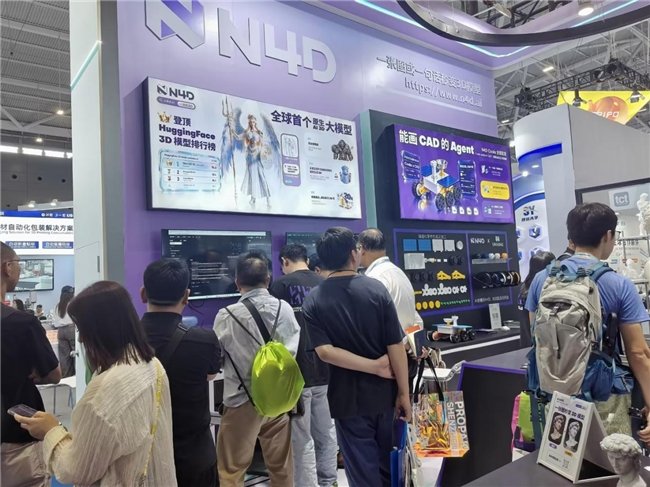
AI and 3D printing are converging faster, bringing creative manufacturing to more people
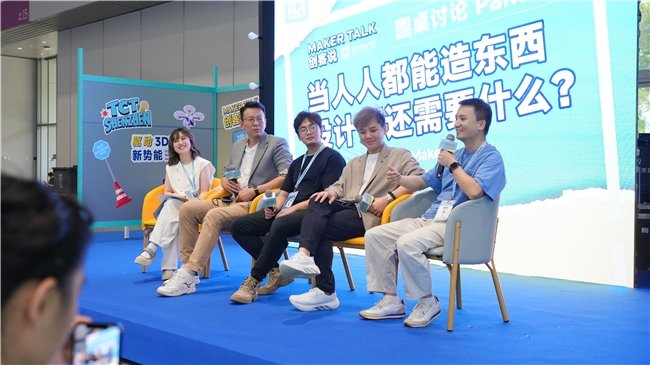
At a presentation titled "GENIUS DROP | Inspiration Drop Program" during the exhibition, Jiang Lei, head of Gezhi Technology, discussed how AI could empower design and manufacturing in light of industry trends.
Jiang said 3D printing is expanding from equipment aimed at early adopters and professionals toward consumer markets and a wider range of applications. As new technologies and products emerge, deeper integration between AI and 3D printing software and hardware may lower the barriers to 3D content creation and physical manufacturing, helping the industry and its application ecosystem grow.
In his view, as intelligent tools enter design workflows, some tasks that once required professional skills can be assisted by AI. However, design involves more than producing a model: it also requires identifying and solving problems around real needs. A creator's aesthetic sense, judgment and responsibility for the design outcome remain important.
Meanwhile, continual technological iteration places new demands on creators. Jiang emphasized that continuous learning, understanding new tools and mastering problem-solving methods help creators adapt to technological change.
Following this direction of AI and 3D printing integration, N4D under Gezhi Technology continues to develop a workflow spanning AI 3D generation, intelligent editing and downstream manufacturing, supporting conversion of digital models into physical applications and exploring further uses of intelligent 3D creation tools in creative manufacturing.
As a company focused on large AI 3D models, N4D aims to lower the barrier to 3D creation. Its image-to-3D, text-to-3D and CAD Agent features offer new tool options for creators, designers and people working in 3D printing.
At TCT Shenzhen 2026, N4D used live demonstrations and industry exchanges to show how AI 3D creation can be applied in 3D printing contexts. As AI generation and 3D design tools develop, combining AI modeling with 3D printing creates more possibilities for personalized design and digital creativity to become physical objects.
As a company focused on large AI 3D models, N4D aims to lower the barrier to 3D creation. Its image-to-3D, text-to-3D and CAD Agent features offer new tool options for creators, designers and people working in 3D printing.
At TCT Shenzhen 2026, N4D used live demonstrations and industry exchanges to show how AI 3D creation can be applied in 3D printing contexts. As AI generation and 3D design tools develop, combining AI modeling with 3D printing creates more possibilities for personalized design and digital creativity to become physical objects.
AI-translated from an article by Kuaixiong on Nanjixiong, originally published on 2026-10-19. Text and images retain the original source attribution.
Read the original Chinese article |


 Record number | ©2024 panda3dp Team. Powered by panda3dp