Nanjixiong introduction: Photocuring is fast and precise but works with fewer materials. Extrusion handles more materials but is slower and coarser. Ryan Truby's Northwestern University team combines the two in DIAL by depositing a paste-like ink, scraping it into a 50 μm layer, and curing it with projected light. A porous grid takes 30 minutes versus 124 minutes by conventional extrusion, more than four times faster, with walls as thin as 150 μm. The paper appeared in Science Advances on November 4.
On November 4, 2026, Nanjixiong learned that Truby's team at Northwestern's McCormick School of Engineering had published Direct Ink Additive Lithography (DIAL) in Science Advances. The first author is mechanical engineering doctoral student Pranav Kaarthik.
Combining Photocuring and Extrusion
For decades, users have traded off speed, precision, and material choice. SLA and DLP are fast and precise but limited to relatively fluid photosensitive resins. Direct ink writing (DIW) works with functional materials including pastes and particle-filled inks, but tracing lines is slow. Smaller nozzles improve detail while increasing the risk of clogging.
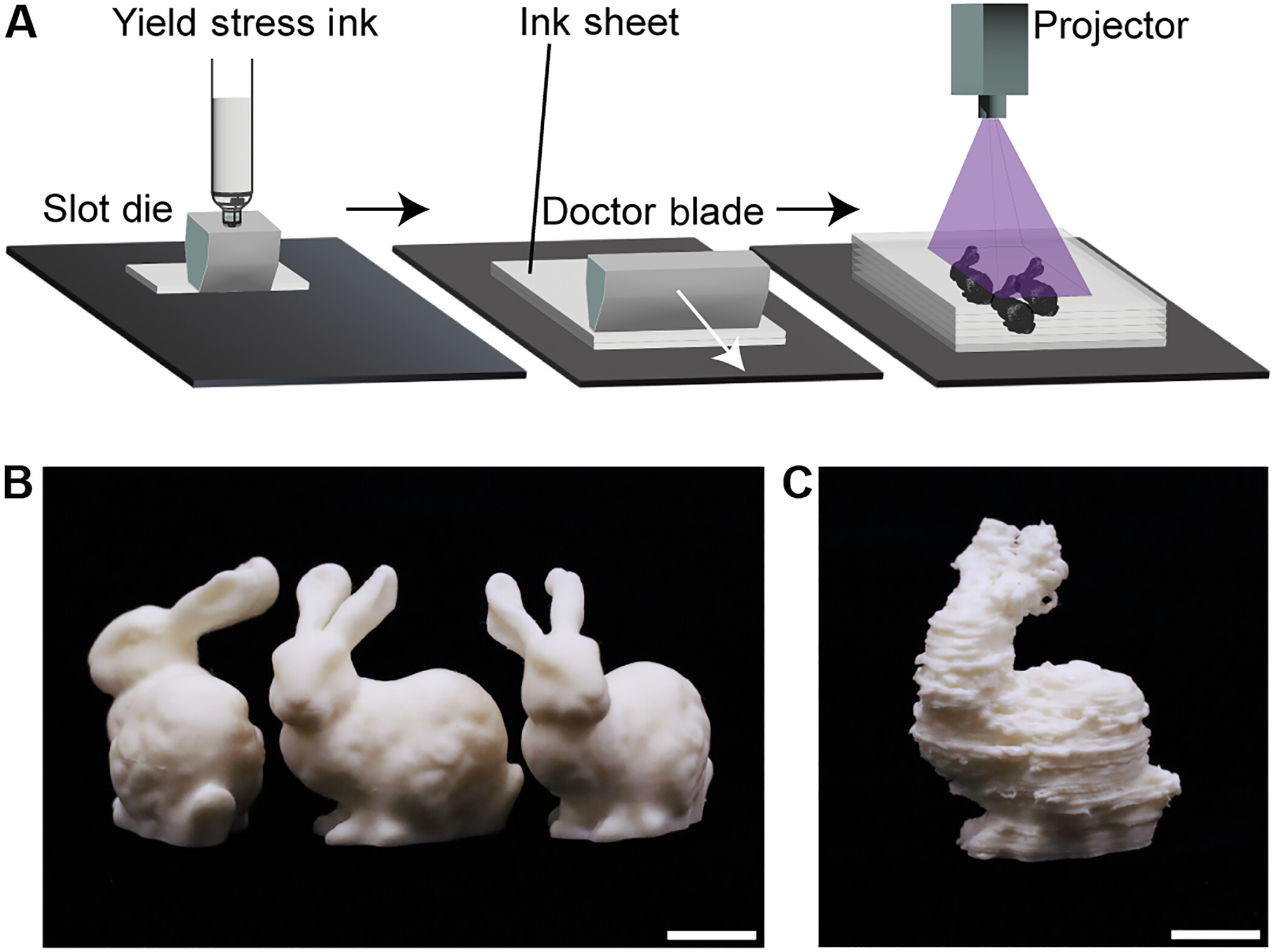
DIAL first deposits a large amount of paste-like ink onto the platform through a slot nozzle. A blade spreads it into a uniform 50 μm layer, thinner than a human hair. A projector selectively hardens it with patterned light. Repeating the cycle builds the part layer by layer.
Resolution depends on the projector pixels and layer thickness rather than nozzle size. This enables fine features without nozzle clogging.
Uncured Ink Supports the Part
Conventional printing requires supports for overhangs. Removing them can break delicate features. DIAL uses the ink itself as support.
Fumed silica nanoparticles give the photosensitive resin a yield stress. Like hair wax, cream cheese, or toothpaste, it holds its shape at rest and flows when stressed. It flows briefly under the blade and recovers stiffness as the blade passes. Uncured ink supports the part, then can be rinsed away and recovered for reuse.
Kaarthik explained that complex parts can collapse without supports, while removing supports can destroy the fine features they were meant to protect.
More Than Four Times Faster, 150 μm Walls, and Interlocking Chain Mail
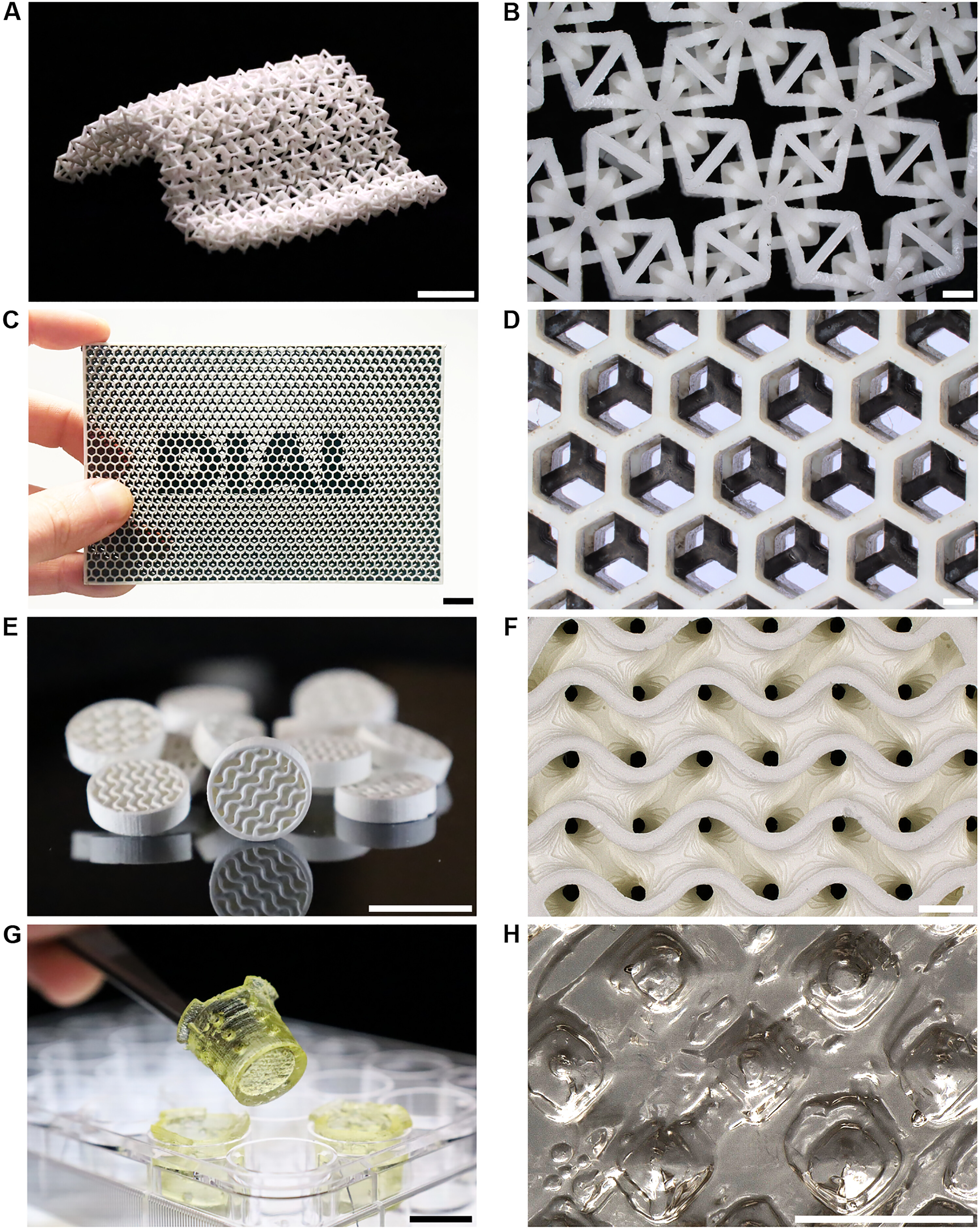
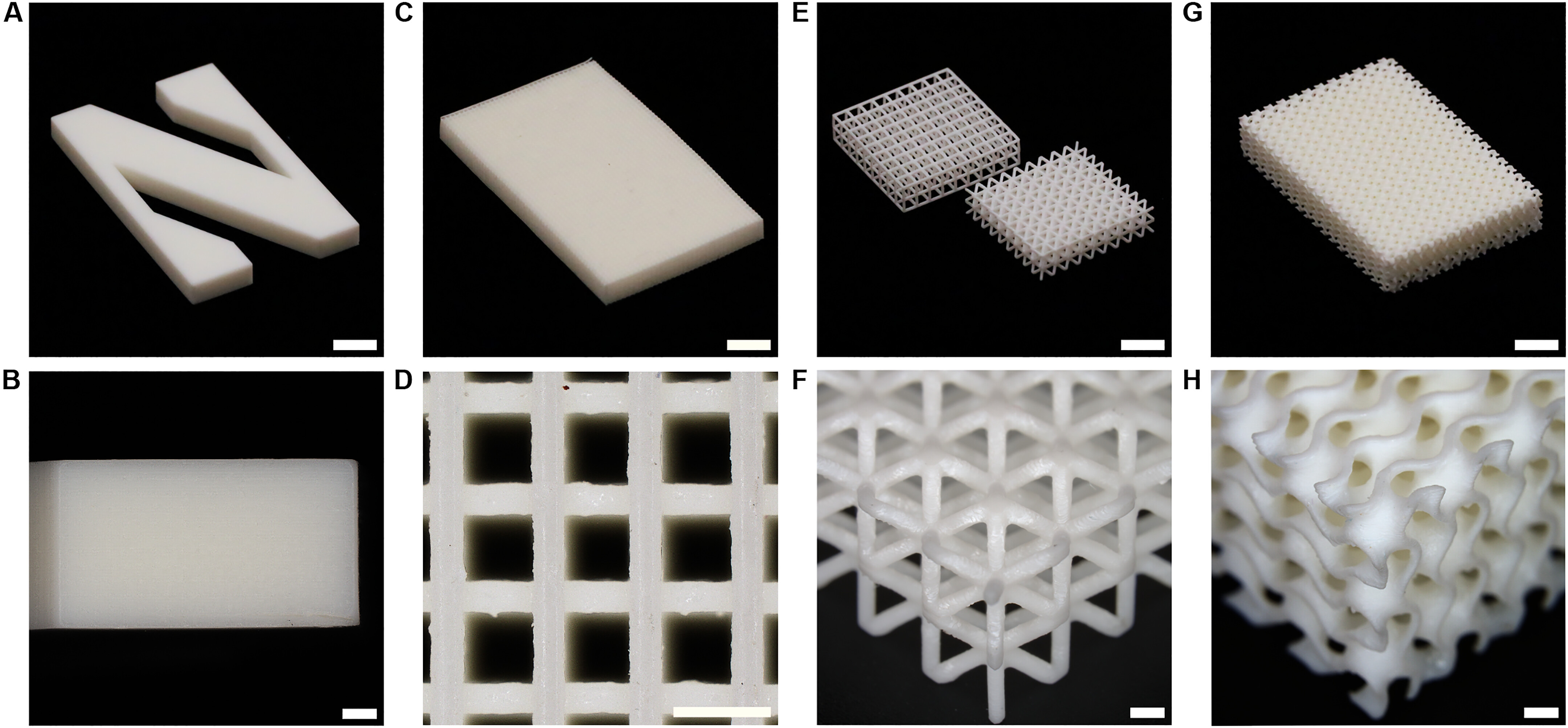
• Porous grid: DIAL took 30 minutes versus 124 minutes for conventional extrusion, more than four times faster.
• Lattice walls reached 150 μm, beyond what the conventional extrusion method could produce.
• It printed interlocking chain mail, a challenge for both extrusion and photocuring.
• Fifteen porous lattices for battery electrolyte structures printed together in 15 minutes.
• The process can print multiple parts together and use different inks in different layers.
• Moving the projector produced a honeycomb four times the projection area. With no immersion in a resin vat, scaling is easier.
Two Functional Materials: Battery Electrolyte and Hydrogel
The team demonstrated two functional inks. A polymerizable ionic liquid, a type of liquid salt, produced a porous structural-electrolyte lattice roughly the size of a button cell. Precisely structured 3D electrolytes could support new energy-storage devices.
A hydrogel, a soft water-containing material that mimics tissue properties, produced a vessel resembling a cell culture chamber, with microscopic inverted-pyramid arrays for cultivating cells and organoids.
Three DIAL-printed Stanford bunnies, standard printing test pieces, against a black background highlighting surface detail. Image: Northwestern University.
Truby said printing these materials required software, hardware, and ink to work together, which Kaarthik and the team achieved with DIAL.
Next Steps: Space, Robotics, and Biomanufacturing
The team is using DIAL to print materials for extreme space conditions, flexible robot components, medical devices, and tissue culture environments for biomanufacturing.
Nanjixiong's Observations
DIAL combines thin-film coating with DLP projection. Slot-die coating is familiar in film manufacturing, but applying it here addresses the trade-off between material compatibility and speed and precision.
Two developments stand out. Working without a resin vat should make larger builds easier in principle. Handling particle-filled functional inks addresses a limitation of photocuring. The electrolyte and hydrogel demonstrations point toward energy storage and biomedical applications.
The method is still at the laboratory stage. Whether industrial users can adopt the inks and whether equipment costs can reach acceptable levels remain open. Turning a paper into a product usually takes time.
Published in Science Advances. Authors: Pranav Kaarthik, Michael Bayer, EunBi Oh, Alexander Kane, and Ryan Truby.
AI-translated from an article by Kuaixiong on Nanjixiong, originally published on 2026-11-05. Text and images retain the original source attribution.
Read the original Chinese article
Cross-posted copies of the same source content have been consolidated into this article. |



 Record number | ©2024 panda3dp Team. Powered by panda3dp