Aircraft structures are among the applications that offer the greatest scope for additive manufacturing. On October 22, 2026, the Sixth Aerospace Additive Manufacturing Conference was held in Shanghai. At the conference, Wu Bin, a chief technical expert at the Aviation Industry Corporation of China and a researcher at the Shenyang Aircraft Design and Research Institute, systematically explained application directions and actual requirements for additively manufactured aircraft structures.
Nanjixiong has compiled the following account based on the presentation. It may contain inaccuracies and is provided for reference only.
01 Where Do Traditional Aircraft Structures Run into Limitations?
Traditional aircraft structures rely on subtractive manufacturing and mechanical assembly, with constrained configurations and extremely low material utilization. A typical large titanium alloy structural component begins as a blank weighing 2–3 tonnes, yet the finished part weighs only 148 kilograms. Material utilization is below 5%, with most of the material removed during machining.
More significantly, to accommodate machining processes, aircraft structures are mostly designed in flat-plate configurations that require numerous mechanical joints. These connecting elements account for 28%–30% of aircraft structural weight, while connection holes are frequent sites of fatigue cracking. Reducing weight and extending service life are therefore recurring themes in aircraft structural design.
02 Why Can Additive Manufacturing Change the Equation?
Additive manufacturing requires no molds, offers a fast response, and can produce complex structures while significantly improving material utilization and reducing cost. This creates an opportunity to free structures from the constraints of traditional processes, allowing design to follow the load path itself rather than accommodate machining.
03 Five Directions: From Part Consolidation to Integrated Functions
Focusing on lower weight and longer life, Wu Bin outlined five application directions.
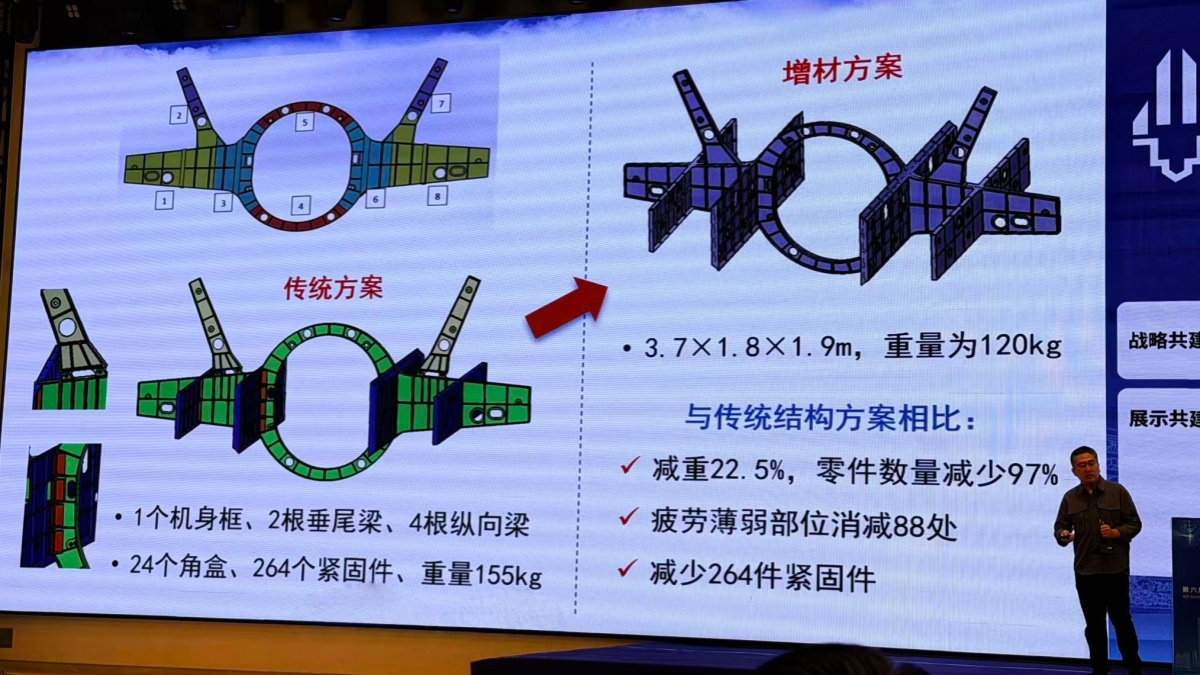
Large integrated structures. Multiple separate structural parts are combined into a single whole. For fuselage frames and wing spars, for example, 150 conventional parts have been consolidated into one integrated component, reducing weight by 20%, cutting part count by 97%, and eliminating all 88 high-risk fatigue hole locations. Structures on a 5-meter scale can already be produced. The future goal is to manufacture integrated titanium alloy or high-strength alloy frameworks measuring 8 m × 6 m with wall thicknesses of 2–6 mm, while strictly controlling geometric tolerances.
Configuration optimization. Instead of generic structures shaped around machining, configurations are tailored to the load path. With the same material and external dimensions, load capacity increases by 13%, and individual component categories can achieve weight reductions above 30%. The future aim is topology optimization of primary load-bearing structures measuring 6 m × 4 m, using high-strength aluminum alloys with material strength of at least 500–600 MPa.
Graded material combinations. Materials with different properties are distributed by region to put the best material where it matters most. Graded applications involving heterogeneous materials of the same general type have already been implemented. However, heterogeneous gradients between aluminum and titanium alloys remain at the laboratory stage. Interface bonding reliability and heat-treatment processes compatible with multiple materials still need to be addressed.
Integration of structure and function. Functional systems are embedded inside airframe structures to share structural space. For example, an additively manufactured airborne heat exchanger improves heat-exchange efficiency by 50%, reduces weight by 40%, and offers better stiffness. Future goals include integrated components more than 4 meters in size, lattice feature dimensions below 1.4 mm, and compatibility with materials such as high-strength aluminum alloys and high-silicon steel.
Rapid trial production. This serves the pilot-scale validation stage of aircraft R&D, which typically requires 2–5 trial-production iterations. Rigid mass-production models do not suit this stage, whereas additive manufacturing matches its need for short cycles and easy capacity expansion. The presenting organization has established a pilot platform for rapid aircraft airframe development covering additive manufacturing, flexible assembly, and performance validation.
04 Next Steps: Intelligent Structures and Open Collaboration
Wu Bin said future technology must move beyond conventional subtractive and additive forming pathways toward large structures integrating functions and structural elements, and ultimately toward intelligent structures. Frontier research directions include thermoplastic fiber printing, integrated printing of circuits and composites, integrated printing of intelligent materials and control systems, self-healing structures, and health monitoring.
AI-translated from an article by Beijixiong on Nanjixiong, originally published on 2026-10-28. Text and images retain the original source attribution.
Read the original Chinese article |



 Record number | ©2024 panda3dp Team. Powered by panda3dp